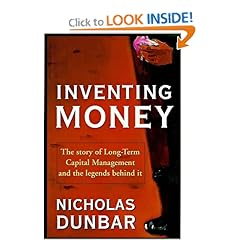
 While Lowenstein's account of the Long-Term Capital Management debacle is more fascinating, Dunbar's book provides more "meat" for those interested in the backdrop of the historical event.Starting with a brief history of speculation and progressing to finance theory, "Inventing Money" places the Long-Term saga in a historical context.Indeed, almost half of the text has nothing to do with Long-Term directly, but Long-Term was not created in isolation.People from academia and "the Street" made its existence possible, and this book chronicles its development very well.
A bit more technical than "When Genius Failed," this book gives the reader lots of background material on the theory behind what Long-Term was supposed to do: namely, arbitrage.As a Ph.D. student of financial economics, I found Dunbar's explanations easy to understand, but I can also see that they will be quite obfuscating to non-specialists in this area.The second part, about Long-Term's dealings, is easier to understand for everyone.While his account of what transpired to Long-Term is not as vivid as Lowenstein's, I think Dunbar does a laudable job at keeping the story flowing.BTW, the paperback addition has a thoroughly updated last chapter, "Aftermath."
If you are interested in the Long-Term story, both books are worth keeping.If you have to choose, go with "Inventing Money" if you are also interested in the history of finance theory and financial engineering; if you prefer an "insider's view," "When Genius Failed" would be a better choice.
Click Here to see more reviews about: Inventing Money: The Story of Long-Term Capital Management and the Legends Behind It (Hardcover)

No comments:
Post a Comment