Showing posts with label Simon and Schuster. Show all posts

3/14/2010

Review of The Pro-Growth Progressive: An Economic Strategy for Shared Prosperity (Hardcover)

The Pro-Growth Progressive is an outline that promotes the agenda of the liberal movement (now self re-named as Progressive). This outline contains both strategy (to link policy ideas to American values of work, self reliance, fairness, equality of opportunites, etc.) and substance.

Both strategy and substance are well organized and mostly balanced. I tend to overlook the occasional rhetoric and one-sidedness, since it was probably inserted to help maintain the interest of the extreme left. In short: this outline is mostly a re-statement of the Clinton adm. domestic policy goals, with some expanded, some re-worked, and with some interesting new ideas presented here.

The main policies suggested here are:

1. Universal 401(k)with $2-to-$1 matching tax credits on the 1st $2,000 invested (and portability, since ALL americans will be offered this program).
2. Universal Pre-school.
3. Universal after-school.
4. Job re-training programs, and education assistance programs.
5. Maintain Social Security in it's present form (fix it by adding a new 3% tax on all income above $200,000).
6. Reject any/all attempts at protectionist trade policy.
7. Maintain and improve the current progressive tax system.
8. Reverse the Bush Tax cuts (at least on the top 2% and on the reduction of estate taxes).
9. Modest increase in Fed. min. wage (to $7.00 - $7.25 in 2006).
10. Expand/increase the Earned Income Tax Credit.
11. Balance the budget (except in times of recession or other national urgency situation).

While most moderates can agree with most of these policies, at least in principle, the author has presented few estimates of actual costs to taxpayers. This summary of costs should have been included in a final chapter - such final chapter was notably absent. The estimated costs are a necessary component of any serious policy discussion and should have been summarized in table form.

Left to my own rough estimates, it seems that the Progressive agenda presented here would cost:
- reverse the Bush tax cuts
AND
- increase taxes BY TWO TIMES the Bush-tax-cut-reversal-amount to balance the budget, to fully fund SS, Medicare, the Universal 401K, etc.

While the policy objectives presented in this outline are noble and honorable, much elaboration is still needed on each item that would further examine the cost of the income transfers and the benefits to America as a whole.

I did enjoy the author's style and his aggressive and fair debate. (BTW, I am a moderate Republican...) His relentless pursuit of a balanced budget is absolutely correct, and the proposal of Universal 401k is also a policy whose time is right. Finally, his analysis that free trade is good for all Americans proves that he is a Democrat that "gets it". It fact, the author thinks like an economist - understands there are ALWAYS trade-offs and secondary effects, and thereby measures his policy goals by their likely overall consequenses to the US economy. (Hence the "pro-growth" objectives.) The major question left TBD is whether the policy results themselves can provide more contribution to a "virtual cycle" or will the costs of poorly re-distributed capital create an excessive drag on the economy (thus hurting those that such policies are designed to help)?


Republicans better get their act together - strategists like Gene Sperling have an agenda that if follwed by Dem candidates - will probably change the political landscape for a very long time. If Democratic candidates were to follow these guidelines, there could be a new majority in congress in 2006 and the WH in 2008.


Click Here to see more reviews about: The Pro-Growth Progressive: An Economic Strategy for Shared Prosperity (Hardcover)

2/03/2010

Review of Ready or Not, Here Life Comes (Hardcover)

Dr. Mel Levine makes some good points in describing why so many of today's young adults have trouble with the transition from the world of school to the world of work. For starters, Levine states that many of the skills needed for school may be different from the ones they will need during a career. For example, think of all the multiple-choice tests you may have taken in high school or at a university. I agree with Levine that these tests really don't prepare a student for anything important in the adult world.

Levine also says that kids need to be more interested in the working lives of people. I think this is a great point. So many kids grow up idolizing sports stars or entertainers. Instead, they should try to make more connections with the adult world. Kids and students should focus on their feasible futures because the odds of making it in sports or entertainment are minute. It also talks about reading biographies of people you admire (to get an idea about how they navigated life). However, with technology and other reasons jobs are changing so fast that, as Levine notes, role models even within a family are an endangered species.

A lot of the advice is very practical. For example, it helps to know what abilities you have, what you enjoy doing, where you see yourself in x amount of years, etc. If you know this, you will not make the mistake of just taking whatever job comes along. This could easily turn into being stuck in a job you hate after awhile. It is important to keep in mind that a willingness to start way down and climb way up is, of course, the American Dream.

Bottom Line: It is a great/essential/interesting read for educators, parents, and students.


Click Here to see more reviews about: Ready or Not, Here Life Comes (Hardcover)

Review of Spend 'Til the End: The Revolutionary Guide to Raising Your Living Standard--Today and When You Retire (Hardcover)

Kotlikoff is a very interesting writer/economist.His previous book The Coming Generational Storm: What You Need to Know about America's Economic Future is a must read for anyone interested in the actuarial position of Social Security.Now, Kotlikoff and Burns focus on financial planning.To investigate it, Kotlikoff developed a sophisticated program (ESPlanner).Its underlying methodology is "consumption smoothing" that consists in evening out your discretionary income over your lifetime.

Per the authors, the financial service industry ignores consumption smoothing methodology for several reasons.First, it is really complicated.It includes many variables (mortgages, change in member of households, AMT, Social Security benefits taxation, etc...).Second, it reduces retirement savings needs.Third, it reduces the investment risk you need to incur to reach your goals.Thus, consumption smoothing would cut into the sales of financial products.

The authors spare no one in the financial service industry.The mutual fund managers don't earn their fees as 70% of them routinely fall behind the stock indexes.And, the 30% that beat the market change every year.Thus, the 30% who beat the market are just Fooled by Randomness: The Hidden Role of Chance in Life and in the Markets.Hedge funds don't have a chance to make up for their high fee structure (1% management fee; 20% of returns).Insurance salesmen care more about their commission than your finances.

The authors are at their best when dealing with the intricacies of Social Security and Medicare.They explain unique strategies to maximize consumption smoothing such as Social Security double dipping.Similarly, you can come ahead by giving to a Charitable Gift Fund because it markedly reduces your taxes on Social Security benefits.They stress how rapidly Medicare premiums are rising and how we should boost savings even during retirement to withstand that fiscal shock.

Many of their other recommendations make good sense.Those include holding stocks in taxable accounts and bonds in tax advantaged ones (IRA, 401k) to lower your tax burden.They recommend using index funds instead of regular mutual funds to save on costs and boost returns.Diversify your 401k holdings away from your employer's common stock to reduce your own portfolio risk.They also suggest that marriage is a good deal from a tax standpoint in most cases.Their chapter on how to hedge against potential increase in taxes and inflation and upcoming cuts in Social Security benefits is very good.Their chapter on long term care is excellent.

But, some of their investment advice is less sound.Kotlikoff recommends inflation indexed Treasuries (TIPs) as a safe investment that is guaranteed to keep up with inflation (just as Robert Shiller did in Irrational Exuberance).But, on an after tax basis TIPs are unattractive. The yield they offer above inflation is really low (< 1.5% for 10 year TIPs).When inflation is higher than 3% you incur negative real returns after tax.This is because the entire return (inflation + yield) is fully taxable by the IRS.Also, TIPs with longer maturities offer little extra yield that does not compensate for the increase in interest rate risk.Thus, with TIPs it is questionable you can preserve capital let alone grow it.As a better alternative, I suggest medium term Munis.

Occasionally, they make errors.Upon retiring, Kotlikoff recommends converting your 401k into a Roth IRA because you may hit the 28% AMT that is lower than the 35% maximum tax rate.But, you don't "benefit" from the AMT because your tax liability is always the higher of the AMT or your regular taxes.Also, Kotlikoff suggests people's living standards go up when home prices fall because they save on insurance premium and property taxes.But, they don't.Insurance premiums are based on the replacement costs of the house.And, property taxes are based on assessed value.Replacement costs are always lower than the home market value.Assessed value almost always is lower too.Thus,in the majority of cases declining home prices will not save you money.

The authors make other questionable statements.Supposedly, on a consumption smoothing basis, a plumber maintains a higher living standard than a doctor.I don't believe that.Also a college education supposedly provides little financial benefits vs just high school.Meanwhile, figures from the US Census indicate that college grads make nearly twice as much as high school grads.I ran the numbers and calculated the NPV of a college education was several hundred thousand dollars.Also, they suggest that having a second child cost either little or is a cost saver.That's pretty hard to believe too.

Occasionally, the authors appear to contradict themselves.Late in the book, the authors share that per the Employee Benefit Research Institute 56% of retirees spend either the same or more than their pre-retirement level.This contradicts the authors' position that the financial service industry advocated replacement rate of 70% of pre-retirement earnings is too high.The mentioned survey instead suggests it may be too low.

In another chapter, the authors oversell the concept of annuitizing assets and reverse mortgages.That's where they push consumption smoothing too far.By annuitizing your assets and getting a reverse mortgage, you wipe out your estate leaving nothing for the next generation.

This financial planning book is a bit too erratic.To build a robust foundation, I recommend instead The Random Walk Guide To Investing.


Click Here to see more reviews about: Spend 'Til the End: The Revolutionary Guide to Raising Your Living Standard--Today and When You Retire (Hardcover)

1/19/2010

Review of The Commanding Heights: The Battle Between Government and the Marketplace That Is Remaking the Modern World (Hardcover)

The second half of the 20th century was marked by the ebb and flow of government influence over national and international economies. Daniel Yergin and Joseph Stanislaw characterize the balance between government and private marketplace clout as a battle for the commanding heights of the economy. They trace this fight back to the years after World War II, where they discover that capitalism had been widely discredited and governments were basking in the glow of wartime victory. With descriptions of the catalytic people and events that moved markets and policy, Yergin and Stanislaw have turned an essentially academic topic into a readable book, which is as much about economics as it is about history. As engaging as the stories are, don't assume you're in for a light read. Many business books today have plenty of sizzle, but not much steak. We at getAbstract recommend that you sink your teeth into this big, juicy T-bone of a book, a rare treat for intellectual readers searching for economic adventure and substantive history.


Click Here to see more reviews about: The Commanding Heights: The Battle Between Government and the Marketplace That Is Remaking the Modern World (Hardcover)

1/03/2010

Review of Gimme Shelter (Hardcover)

Very, very funny. I only wish we had this hilarious handbook during the two miserable years we spent searching for plausible, affordable real estate within commuting distance of Manhattan.


Click Here to see more reviews about: Gimme Shelter (Hardcover)

12/03/2009

Review of Jim Cramer's Real Money: Sane Investing in an Insane World (Hardcover)

I loved the book!I hated the book!And I have recommended it to many and continue to do so, but with caveats and frustrations.

First, if you haven't watched Cramer's `Mad Money' program at least once on CNBC, you need to do so.One show will give you more insight into Cramer's emotional make up and give you more of what to expect from his writings than any review!He is, at once, informative, opinionated, contradictory and entertaining.Well, my wife would disagree about the latter!

Second, like him or not, he is one of those rare investment book writers whose track record is quite public.And he has practiced what he preaches to make (and lose and make again) millions in the market, mostly using other peoples money!To ignore someone with his success is not smart, but to take anyone's investment opinion as the `only truth' is equally risky.

So, let's get to why I stated that I loved this book.Because I do strongly recommend this book to people relatively new to managing their own investments.I especially appreciate his `buy and homework' mentality since many people try to manage their investments without accepting that there is indeed work to be done.He does a good job of explaining why fundamentals are important and how to utilize basic measurements.He does a very good job in explaining market cycles, especially the major ones that cause `big money' (pension funds, mutuals, etc.) to move in and out of various sectors.In general, this is an excellent first read for people new to investing and a reminder of some basics for the rest of us.

Okay, so why did I sometimes feel that I hated the book. Well, first let's acknowledge that there is no perfect investing book or system.There are too many variables, especially those that include each investor's personal status - time available to do the work, time horizon before retiring, money available, etc.Every writer brings their own background and bias into their writings and, in turn, tends to become dismissive of other thoughts.But if you read many differing investment books by successful traders, you will find that the methods that they use differ and are at odds with each other.While I generally like Cramer's honesty, I find that sometimes he dismisses some investing methods out of hand which, since this books and programs are targeted to the average investor, serves to bias people based on his own personal biases.Some examples:

a)Jim is a `fundamental' investor - he relies on more traditional analysis of a companies balance sheet and earnings to determine whether to invest in a stock.That is fine, but he goes on to essentially dismiss people who trade predominantly on technical analysis, with a portion of his book essentially saying "nobody has ever made any money trading that way." This is simply not true.Technical trading is simply a different type and method of trading and, indeed, many people have made significant money trading based upon technicals and combined fundamental + technical strategies.While Jim may not use technicals, his wife does, and quite successfully according to him.So dismissing anyone using or promoting technical analysis in the book does not serve the reader. It simply supports his bias.

b)While not in the book, you will find if you read more from him or watch his program that he dismisses alternative investments like options.Again, it is not that the average investor should jump into options without having clear knowledge and understanding of the risks, but to simply dismiss other investment area is to do a disservice to investors who wish to advance and learn more about various markets. (Options, for example, are as risky as stocks - no more so.Their risks, however are different and the knowledge needed is greater than for straight stocks, but given the investor's willingness to learn and understand options BEFORE beginning to trade them, options can actually REDUCE the risks of stock investing.)

Cramer strongly advises against simply following any advisors opinion to guide stock investments, yet sometimes his dismissals without substantiation serve the same purpose for those who may `believe' only Jim Cramer.

So, I highly recommend this book, especially for people who are relatively new to managing their own investments.Even people who only have a 401k can learn a great deal that can help them do a far better job managing the limited options most 401ks offer and improve their results.This is a great starting point for the average investor.But don't become so enamored with Cramer's forceful style that you stop thinking for yourself.Take his advice - learn from his experience - put it into practice = become comfortable that you can implement it and make money from it.And then, when ready, keep your mind open to the many other investment methods and markets that exist.Each requires study and work, but if your temperament, time and dedication allow you to, you may find it even more profitable to move beyond this first step.


Click Here to see more reviews about: Jim Cramer's Real Money: Sane Investing in an Insane World (Hardcover)

11/27/2009

Review of Building Wealth (Hardcover)

Russ Whitney's book was just the information I needed to begin my ascension from bankruptcy to financial independence.I saw an ad in the newspaper for an investment seminar he was sponsoring.While there was no way I could afford to attend it, the book was the perfect solution.I bought it.I was completely riveted, motivated and inspired.I couldn't help but take action on the concepts he detailed.Within one month of reading the book, I bought my first investment property.Within 10 months I had nine more.I, of course, had no money and bad credit at the time and was able to overcome it all with the information he provided.His style is relaxed and easy to read.He takes a complicated financial subject and makes it possible for the layman to assimilate and put into practice.He made me feel that if he could achieve wealth rising from a $5 an hour job as a hog slaughterer that anyone could.I believed him and it sure paid off.I'm now working on a success story of my own!I highly recommend this book as a must for any would be investor.Even now as an accomplished and experienced investor, rereading the book still provides me with new insights and I now see different levels of techniques to try.If you are not inspired and educated by this book, you may be completely without passion!Get the book, you'll be glad you did!


Click Here to see more reviews about: Building Wealth (Hardcover)

11/04/2009

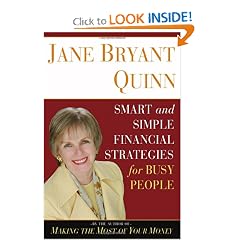
Review of Smart and Simple Financial Strategies for Busy People (Hardcover)

This outstanding book motivated me to overcome nine years of inertia regarding financial planning.My husband and I have been vaguely worried about not saving enough for retirement or college, but we kept procrastinating research into the myriad of competing plans and investments and strategies.

Fortunately, Jane Bryant Quinn has done the research and makes clear, solid recommendations about how to manage family finances.She covers all of the financial bases (including insurance and wills), so that you can be confident you haven't left anything out.

She helps you establish clear financial goals, and explains which type of investments work best for various goals.Once you create your financial plan and set up automatic deposits into your investment/retirement accounts, she recommends you leave them alone and make adjustments as needed once a year!No time and energy wasted on buy/sell decisions after each stock market wiggle.

Now granted, this investing program is unlikely to provide the spectacular returns that some lucky people have made in real estate or by timing the market.But Quinn argues that people who earn huge returns on their investments are really few and far between.Furthermore, she points out that those investors take on a lot of risk in order to get those kinds of returns.

Her book is more than "common sense" however, - in fact, some of her ideas fly in the face of popular belief.For example, I was convinced any financial plan would have to begin with a strict budget that would ruthlessly prune lattes etc... out of our lives.Quite the contrary - Quinn says that the "latte factor" is not a significant factor in a family's financial health - it's the big ticket items that show up on credit card statements.

Rather than attempt to budget and plan in ADVANCE where non-essential money goes, Quinn recommends you automate deposits to your savings/retirement accounts because you, in turn, will automatically, subconsciously, and painlessly start reining in your expenses to match the size of your checking account.It's an interesting theory, and one I want to start ASAP, as my efforts to budget every expenditure and invest anything left at the end of the month have not been very successful.She does say, however, that if you are habitually living beyond your means, racking up major credit card bills, etc..., you'll need to get that under control before you can really implement/benefit from most of the strategies in this book.

All in all, an excellent book full of sound, straight forward ideas that anyone can implement - no matter how busy.


Click Here to see more reviews about: Smart and Simple Financial Strategies for Busy People (Hardcover)

10/31/2009

Review of Bold Endeavors: How Our Government Built America, and Why It Must Rebuild Now (Hardcover)

I lived through the bankruptcy of New York City.It was a very disturbing experience.At one point garbage was piled high on the streets.

The author of this book helped save New York City.He chaired what was called the Municipal Assistance Corporation ("Big Mac") that forced all parties, including rich bankers, to sacrifice to save New York.It worked.

This book should help bury once and for all the fantasy that "big government" played no role in U.S. history.It details how government intervention again and again shaped U.S. economic policy.

Today, as the author points out, America is literally falling apart as result of a 28 year fantasy that "government was the problem".

Read this book.It's not written by an abstract intellectual.It's written by somebody who actually worked with real people to help one of America's biggest cities recover from a disaster produced by excessive government borrowing. American has had "credit card government" since 1981.Now we face a day of reckoning.This books gives insights on a way out of today's mess.


Click Here to see more reviews about: Bold Endeavors: How Our Government Built America, and Why It Must Rebuild Now (Hardcover)

10/27/2009

Review of Jim Cramer's Stay Mad for Life: Get Rich, Stay Rich (Make Your Kids Even Richer) (Hardcover)

In Stay Mad for Life, Jim Cramer addresses a whole range of financial issues that he hasn't dealt with on his Mad Money TV show and in his prior books.He takes a step back from his primary focus of teaching his viewers and readers how to select individual stocks and presents his approach to broader issues of personal financial management that one deals with from cradle to grave.In this sense the book deals with quite basic topics such as avoiding or getting out of credit card debt (about nine pages), creating and following a budget (about twelve pages) and obtaining health and disability insurance.These topics may seem elementary, even boring compared to the topics of Jim's earlier books, but are issues that people of limited financial experience need to learn about.

On the topic of retirement planning he talks about the advantages and disadvantages of 401(k) plans and of traditional and Roth IRAs.He likes 401(k) plans for their employer-dollar-matching feature but dislikes their limited choice of offered funds and their associated expenses.He advocates funding your 401(k) only up to the point where you've reached the maximum employer match.Beyond that he strongly advocates putting additional retirement dollars into an IRA where the range of choices of investments is so much broader.

In the category of family finance he advocates getting your children interested in investing as young as possible and lists six stocks that you might want to buy just one share of for your child that might pique their interest.That same chapter covers college and home financing.

In his prior books Jim has created lists of rules for investing and he does so again in this book.These twenty rules came from distilling his experience with the investments he makes for his charitable trust that he often mentions on Mad Money.For example one of these new rules that I've found myself prone to violating is "Don't quit when you get back to even". If you've taken on a position in a stock and if the price then drops significantly, it's easy to feel so grateful if/when it comes back up to your break even point, you bail out with a small profit.Jim contends that if the fundamentals of the stock are still good, hang in there with it for additional upside.

In the next to last chapter, Jim really hangs himself out on a limb by selecting five sectors that he thinks will be strong for the next five years and climbs even further out on that limb by naming twenty stocks that he thinks will do well over that time frame.I'm a subscriber to his Action Alerts e-newsletter where Jim announces the buys and sells that he plans to make for his charitable trust.At the time of this review, 16 of the 20 stocks are presently held by the trust and the other four are stocks that Jim has mentioned many times on Mad Money.

In the final chapter Jim makes what must be a major concession for him since he's such a strong advocate of selecting and holding individual stocks.At several places in the book he recommends that if you really aren't willing or able to devote the time and effort to individual stock selections (remember - his tough homework rule is one hour per stock per week!) your next best choice is a low cost passive index mutual fund such as the Vanguard VFINX.However if you REALLY want to invest in an actively managed mutual fund, Jim has conducted research and come up with a list of 13 recommended funds. In doing this research he looked at historical fund performance for the seven-year period 2000-2006.He gives especially heavy weight to fund performance in the three down-market years 2000-2002.He also emphasizes the importance of the fund manager and considers only funds where one manager ran the fund.

I recommend the book for those wanting a good (strongly opinionated) survey of the major issues of personal finance.For those not so interested in basic personal finance, just skip the first five chapters and read the final four chapters which stand on their own and will be of interest to the regular followers of Jim's books and TV.


Click Here to see more reviews about: Jim Cramer's Stay Mad for Life: Get Rich, Stay Rich (Make Your Kids Even Richer) (Hardcover)

10/20/2009

Review of Cash In On Cash Flow: How to Make Full-Time Income with Part-Time Effort in America's Hottest New Business (Hardcover)

Cash In On Cash Flow is one of the most clearly written and well organized books that I have ever read on business opportunities or investing.Mr. Pino presents an excellent overview of the entire cash flow industry.At the same time, he explains the initial step-by-step actions required for one to profit from brokering and/or investing in each type of cash flow.This book was written by someone who has learned his subject through practical experience. Mr. Pino also possesses, a sometimes rare gift among authors, the ability to teach others.I wouldrecommend this book to anyone who is interested in the cash flow and discounted paper businesses.


Click Here to see more reviews about: Cash In On Cash Flow: How to Make Full-Time Income with Part-Time Effort in America's Hottest New Business (Hardcover)